AxiomWeaver Alpha: Desktop Writing Tool for LitRPG Authors
By Rob Chipman
AxiomWeaver is a desktop writing tool for LitRPG and Progression Fantasy authors. It tracks your characters, your world, and your events chapter by chapter, stat by stat, so you can write without losing the thread of the world you're building.
Mac, Windows, and Linux. Free during alpha. No account, no waitlist, no strings.
The LitRPG tracking problem it solves
You're writing chapter 47. You need to know: what are Kira's current stats after the wraith fight in chapter 31? Has she used Void Step since then? How many Rift Crystals does she have, and what did she have before the ambush?
The answer is somewhere in a spreadsheet, a Google Doc, and your own memory. None of them talk to each other. You know this because you're reading a blog post about a tool that solves it.
One author at the top of the LitRPG genre, someone with millions of readers across multiple published series, still tracks all of this in a massive custom spreadsheet. It works. Barely. But if that's the best solution at the highest level of success in the genre, no general-purpose tool is going to get you there. You need something that understands what a character is, what an event is, and how they're connected over time.
That's what AxiomWeaver does. The editor, the world database, and the event timeline in one window, all connected.
Your spreadsheet has served you well. It doesn't know what chapter it is.
What's in the alpha today
Entity scanner. Add a character to your Lexicon (one right-click from the prose) and AxiomWeaver recognizes their name everywhere you've written it: underlined, linked to their Lexicon entry, one click to see their current state. Past mentions light up retroactively. Future ones are caught as you type. It's Aho-Corasick pattern matching, not AI. Your manuscript never leaves your machine.
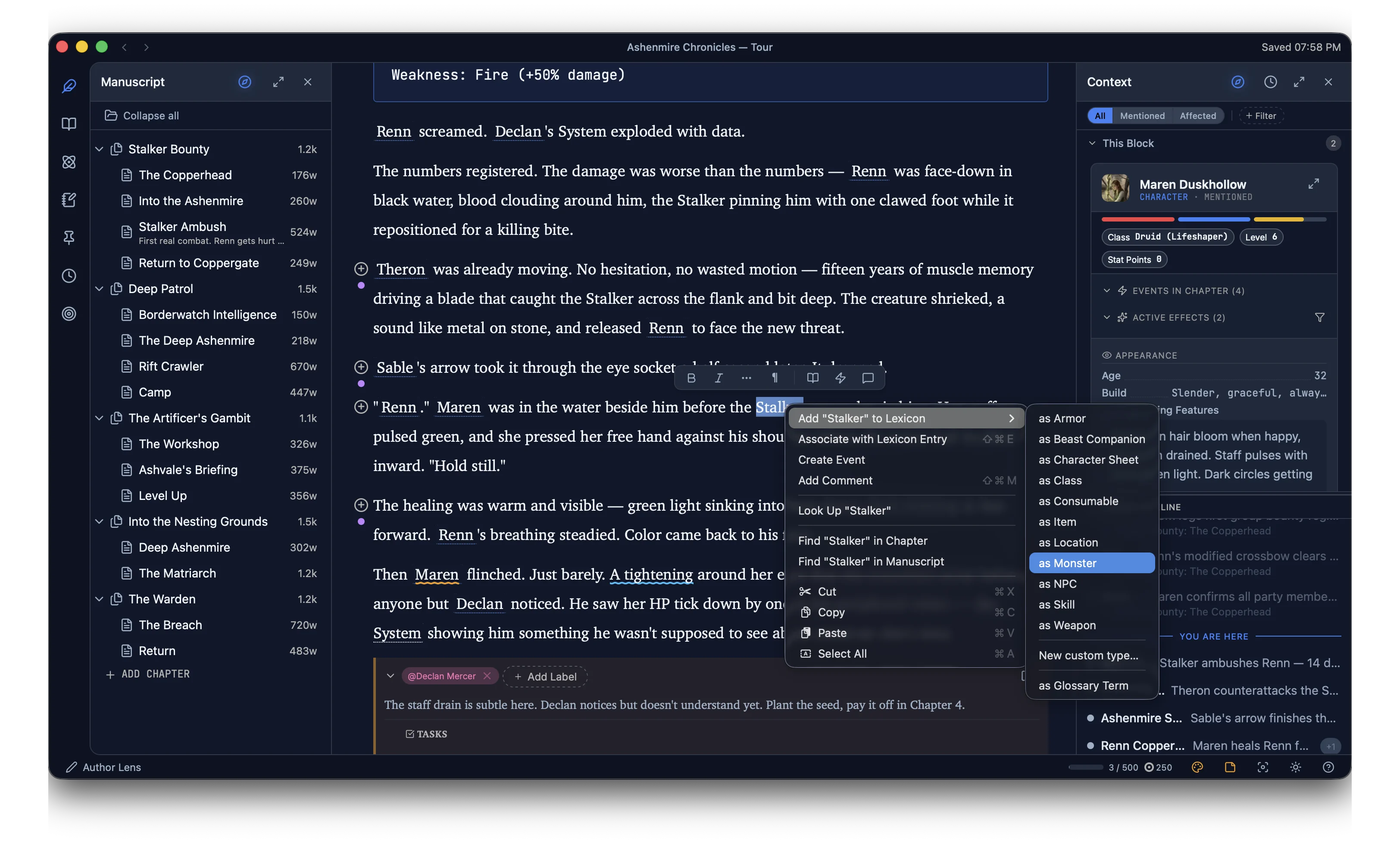
The Lexicon. Characters, locations, factions, items, monsters. All of them live as structured records with typed properties and relationships. Define a Warrior template with STR, HP, and a skills list. Every character built from that template inherits the structure. Template inheritance works the way you'd expect: a Cursed Blade inherits from Sword, which inherits from Weapon, but suppresses "droppable" because it's cursed.
Event ledger and world-time entity reference. Every change to your world is a recorded event: "Kira takes 340 damage," "levels to 12," "acquires the Rift Crystal." Hover any stat and see every source: base value, equipment bonuses, buffs, level-ups. Every modifier, traced.
More importantly, the engine tracks when in your world's timeline each event happened. Write a flashback scene set three years before your current arc, and the hover cards for every character show their state at that world-time, not their current level. Add an event in the flashback that drains Kira's mana reserves, return to your present-day scene, and any downstream scenes where she'd fall below zero get flagged automatically. The engine propagates forward. You don't have to.
This is what I've been calling the narrative engine. It's fully operational in the alpha.
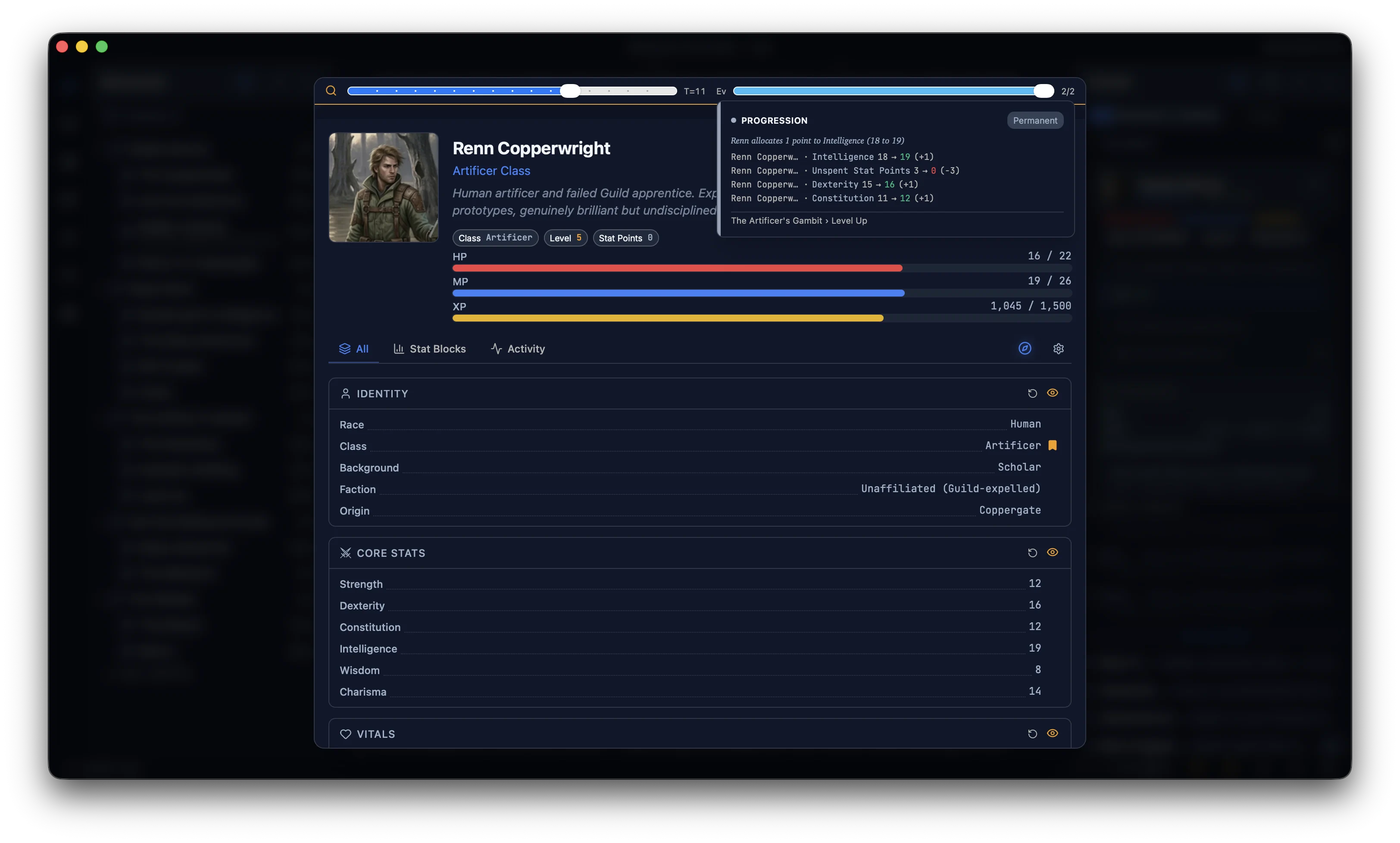
Context Panel. Entity state at your cursor position, without switching views. Write a fight scene, glance right, see Kira's current HP, active effects, and equipment. No tab-switching, no context loss.
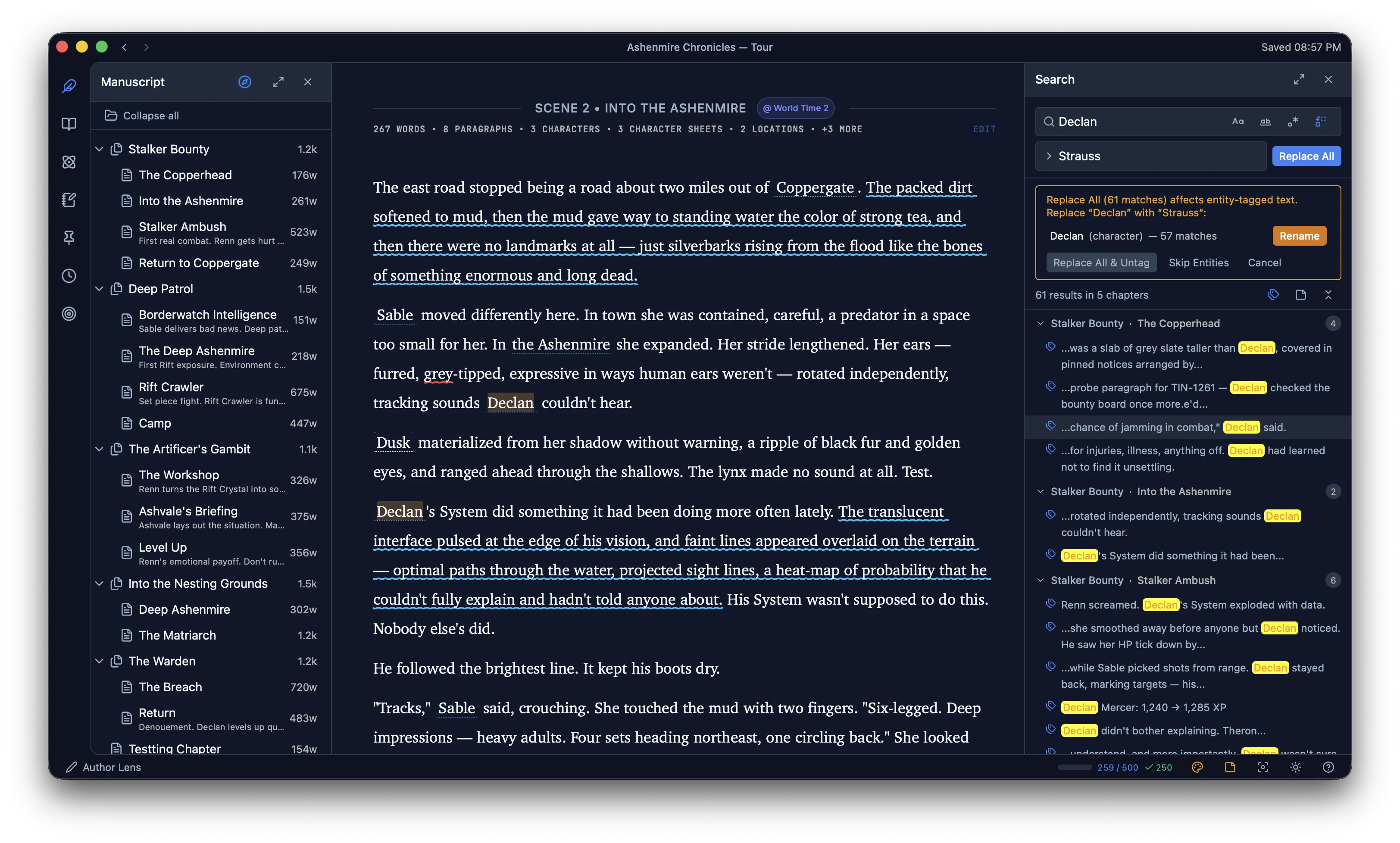
Find & Replace with entity-aware rename. Full manuscript search with regex and scope filtering. When you replace "Declan" with "Chad," the engine detects that Declan is an entity-tagged character and asks whether you want to rename the Lexicon entry in sync, untag the occurrences, or skip entities entirely. One action, everything stays consistent.
World-aware spellcheck. Harper-powered grammar that knows your character names aren't typos.
Skill trees. Tier prerequisites with unlock conditions and stat grants. Swordsmanship I before Swordsmanship II. Progression tracks attach to characters and unlock states propagate through the event ledger. More on how this works for LitRPG systems.
Pinboard. Corkboard view of your entities and their relationships. Navigate from a faction to all its members, locations, and related events without running a search.
Multi-format import. Bring in a .docx, .md, .txt, .epub, or Scrivener project with structure detection. If you've been writing somewhere else, you don't have to start over.
What's not in the alpha yet
EPUB, PDF, and DOCX export. Markdown and plain text export work today. The rest of the publishing pipeline is the first thing on the v1 workbench.
Narrative Event Composer. Guided event creation: type "Kira defeats the Stone Golem" and it auto-generates stat changes, XP, and loot based on your world's rules. The pieces are there; the composer UI is in progress.
Full Reader Lens toggle. The engine already tracks world-time entity state separately from what the reader has seen. The explicit toggle UI and full spoiler-shield layer are gated for post-alpha. Authors building toward a reader-facing wiki can start recording that data now.
Story Web. A visual narrative map showing entity journeys across the manuscript. Post-v1 feature.
What it costs
Free during alpha. No time limit, no feature gating.
V1 will be a subscription. I have a rough price in mind but I'm not locking it in yet. How much real-world use the alpha gets, what breaks, and what turns out to matter most to authors will all feed into what I charge and when I pull the trigger on a paid launch. If you're in the alpha, you'll have a say in both.
Why this exists
This started January 30th with a note I wrote to myself: I want to write a LitRPG novel. I can't keep the world straight in my head.
The stats, the skills, the inventory, the relationships - it's a database, and I was running it manually. I made mistakes. I lost track. The cognitive load blocked the creative flow. I looked for a tool that solved this. It didn't exist.
So I built one. Not for money. Not for a business plan. Because I need it.
I'm one person. What made this possible is a way of working I'm still learning to fully articulate - Claude as planning partner, implementor, and the engineering force behind every layer of the stack. Product direction, ideas, architecture, UX decisions: mine. The Rust engine, the TypeScript frontend, the system design that holds it together: built in collaboration with an AI that could actually execute. This project started as a deliberate exercise - I work in engineering management and wanted to understand agentic development from the inside, to know what this shift in software actually feels like at the seams. What I didn't expect was how much I'd care about the thing I was building. It stopped being a learning project somewhere around commit 400 and became something I couldn't put down.
To be direct about something: there are no plans to put AI into the tool itself. No writing assistant, no suggestion engine, no co-pilot in the editor. AI is how I built this - not what it does. AxiomWeaver is a database and a timeline engine and an editor. The writing is yours.
2,802 commits. 235 tickets closed. Four months of evenings and weekends. The thing that exists now is the thing I couldn't find.
Getting it into the hands of real authors - that's the point. You'll find edges I haven't hit. You'll build worlds I haven't imagined. And your feedback will shape what this becomes. I can't wait to see what you create.
Because there's a lot further this goes. The author builds the world - eventually, I want readers to live in it. Interactive world data, entity state at their fingertips, spoiler-shielded to exactly where they are in the story. And beyond that, something I'm not ready to talk about yet: the same ledger underneath a story that moves, responds, and has actual gravity. Where the world an author builds becomes something a reader can inhabit in ways prose alone can't reach.
That's where this is going.
How to give feedback
Discord. I'm there daily. Bug reports, rough edges, "this doesn't work the way I expected" - all of it is useful. There's also a feedback button built into the app that goes directly to me.
Mac is the primary development platform. Windows and Linux are available but have had less real-world testing. If something breaks, report it. Those platforms are a priority to stabilize.
Windows SmartScreen warning: The installer isn't code-signed yet. That's coming before v1. When Windows flags it, click "More info" then "Run anyway." It's not ideal, and I know it asks for a leap of faith. Code signing is on the pre-launch checklist.