Why LitRPG Authors Need a Narrative Engine
By Rob Chipman
You've built The Spreadsheet. I know you have.
It started simple: a character stats tab. Then items. Then locations. Then a cross-reference sheet for "who knows what." Then a formula to calculate Kira's HP at chapter 31 after the Wraith ambush, minus the health potion from chapter 28, plus the +15 VIT buff from the enchanted armor in chapter 19.
At some point, maintaining the tracker became harder than writing the book.
Fiction with rules
LitRPG is different from other genres because your world has actual mechanics. Not just "Kira is strong." Kira has 42 STR, 1,200 HP, and a shadow-enchanted blade that grants +15 damage. Readers expect the math to work. And they will absolutely let you know when it doesn't.
The Royal Road comment every LitRPG author dreads: "um actually she couldn't have used Void Step there, she burned her mana on the Wraith ambush two chapters ago."
That specific shame of getting your own system wrong. If you've felt it, you know.
The context switch that kills your flow
There's a moment every LitRPG author knows. You're deep in a fight scene, the pacing is working, the tension is right there, and you have to stop. Open the spreadsheet. Find the right row. Update the HP. Calculate the new mana. Check whether that skill had any uses left.
That context switch is where consistency goes to die. Because sometimes you're too deep in the scene to interrupt it. You'll update the tracker later. Later becomes the end of the chapter. Then you're two chapters ahead, the numbers don't match, and you're not sure which ones to trust anymore, so you pick something that feels right and hope the readers aren't doing the math.
Some are. They're always doing the math.
One author I talked to on Royal Road described keeping a separate private fiction (not published, just a shadow document) where each chapter maps to the stat state at that point. A parallel book of bookkeeping maintained alongside the real one. That's not a broken system. That's what dedication looks like when the tools are failing.
The four-tool shuffle
I've spent months talking to authors on Royal Road about how they actually work. The setups are remarkably similar:
- Google Docs for prose
- A spreadsheet for stats
- Obsidian or Notion for the wiki
- Their brain for "what has the reader figured out so far"
Four tools. None of them talk to each other. None of them understand that your story has a timeline.
The scale problem
The four-tool setup is survivable in the early chapters. At 20 chapters, most authors have it roughly under control.
By chapter 50, the cast is bigger. More skills, more equipment, more relationships, more revealed secrets. Authors I've talked to on Royal Road describe hitting a wall around this point: the cast has grown past what they can hold in their head, and every new scene becomes a logistics exercise: who's where, who knows what, whose arc hasn't gotten attention in six chapters. One author called it the "too many cooks" problem. Another described their first attempt at a 7-book series collapsing halfway through book one because the complexity became unmanageable.
This is where pantsers and plotters converge on the same failure mode. The plotter's outline stops matching reality. The pantser's mental model starts contradicting itself. Both are dealing with the same root cause: the world got too complex for the tools they're using to track it.
Some authors respond by simplifying their systems: fewer skills, milestone leveling instead of tracked XP, vague gold counts instead of exact numbers. That's legitimate, and often good story design. But for authors who want the crunch, whose readers show up specifically because the math works, simplifying is a concession to the tools, not a creative choice.
The temporal problem
Here's what a spreadsheet can't do: tell you what was true at a specific moment in your story.
A spreadsheet knows Kira has 1,200 HP right now. It doesn't know she had 847 in chapter 31 and 432 in chapter 38. Every time you need to check "wait, what were her stats at this point?", you're manually cross-referencing cells with chapter notes.
Your world-state changes over time. The tool tracking it needs to understand time.
Events, not cells
A narrative engine treats world-state changes as events anchored to your manuscript:
- Chapter 12: Kira acquires Soulreaver (+15 Shadow damage)
- Chapter 28: Health Potion (HP +500)
- Chapter 31: Wraith ambush. HP -340, Mana -200
Now you can scrub to any scene and see the world-state at that exact moment. "What was Kira's HP in chapter 31?" is an instant lookup, not a manual cross-reference.
Character sheets update automatically. Equipment, buffs, and stat modifiers, all computed from the timeline. The math does itself. For a full look at how authors currently handle this and where each approach breaks down, this post on tracking character stats across a LitRPG novel covers the details.
Here's what that looks like in practice. Two screenshots of the same character, Theron Voss, taken seconds apart. There are two scrubbers: one navigates between scenes, and a second (blue) scrubs through individual events within a scene. Between these two shots, the blue scrubber moved forward by one event:
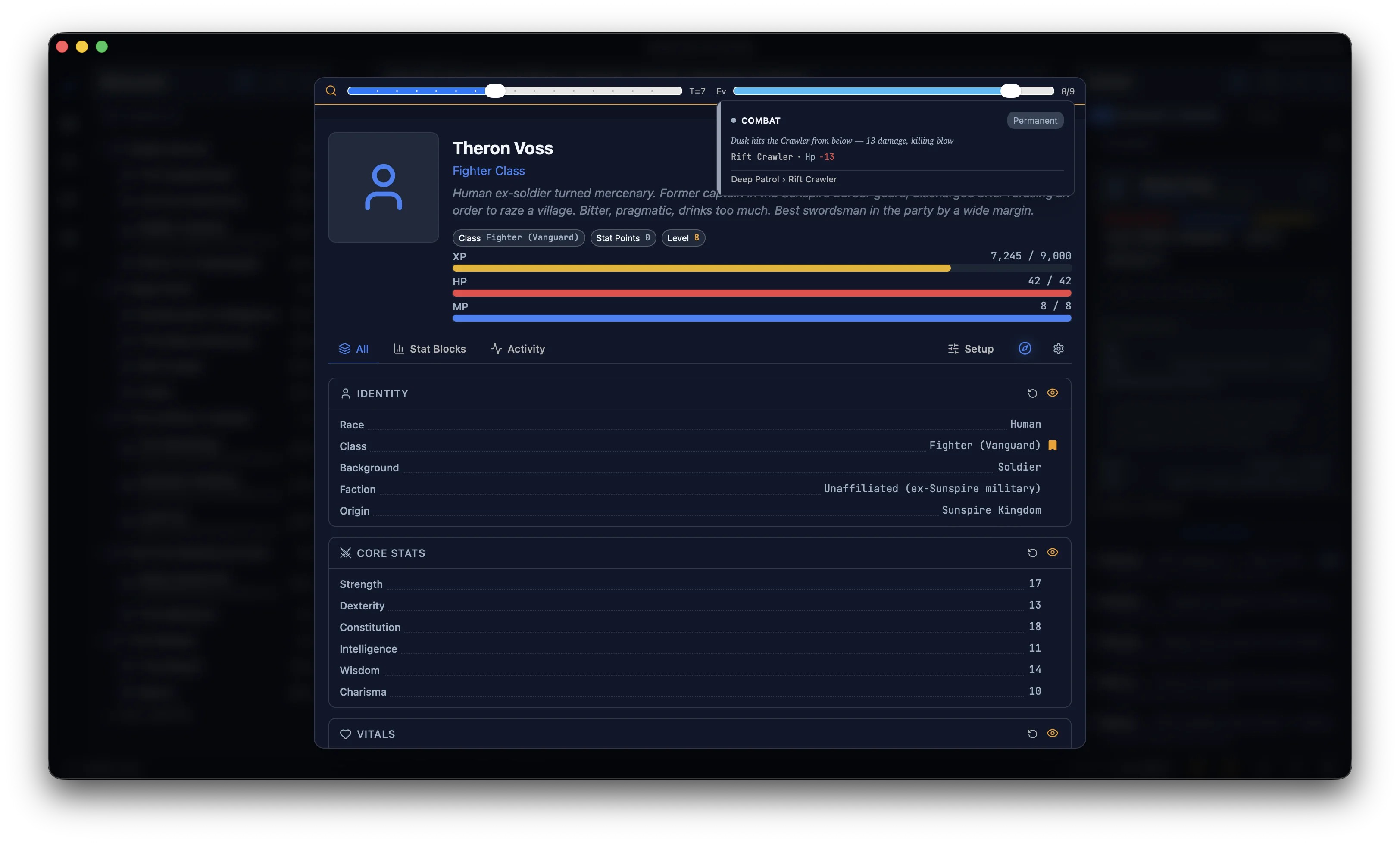
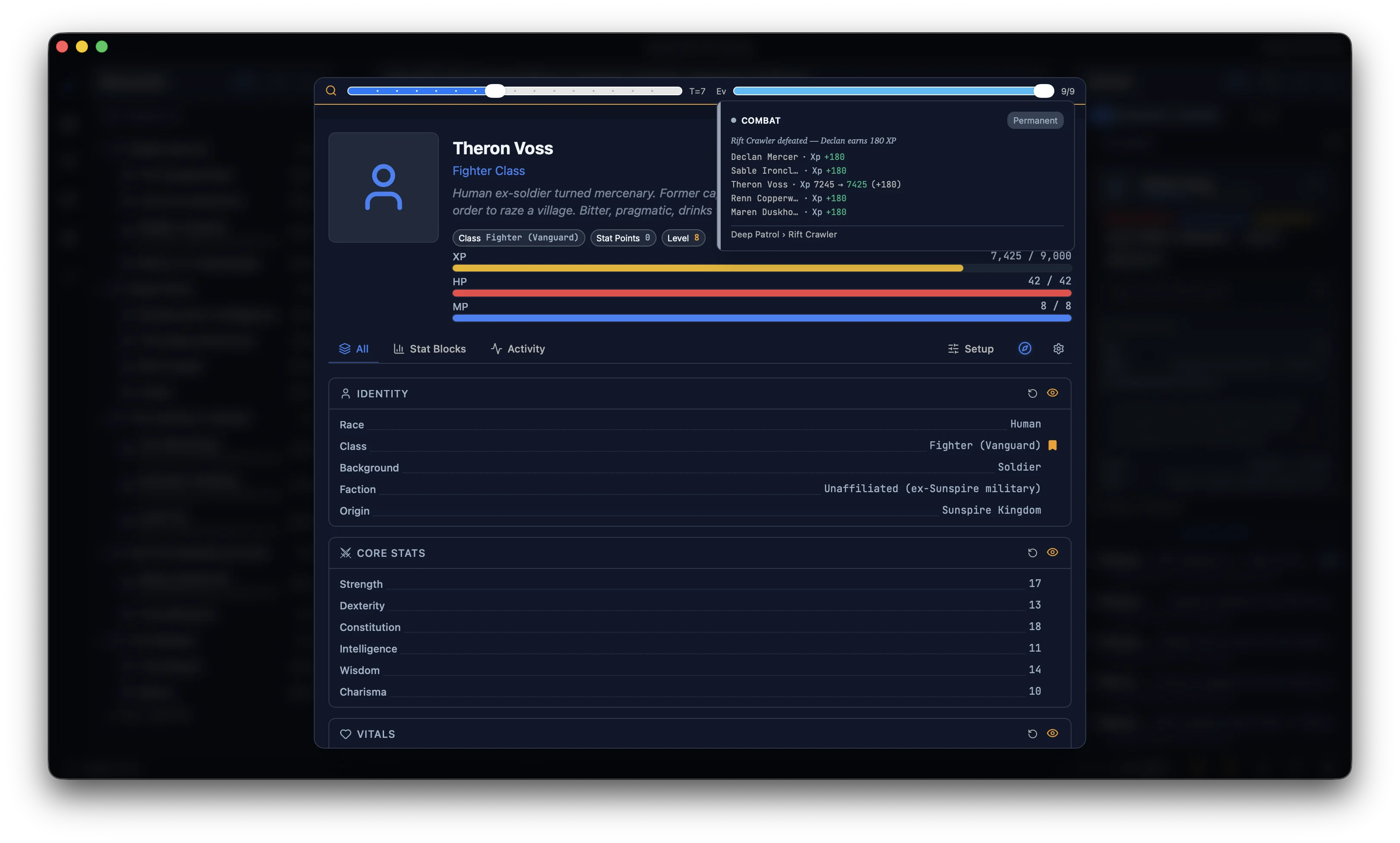
One event forward. One field changes. Everything else stays the same.
That's the granularity of the event ledger: not chapter-level, not even scene-level, but event by event within a scene. Move the scrubber back and the XP reverts. The engine isn't maintaining a current state you have to keep updated. It's replaying the history on demand and computing the answer.
The other tracking problem
Stats are the obvious case. But there's a harder one: knowledge.
What does the reader know at this point in the story? What's been revealed? What's still hidden? If you're writing a mystery subplot alongside your progression system, you're tracking two layers of truth:
- Author Truth: everything you know
- Reader Knowledge: what the prose has revealed so far
Toggling between those views (checking "has the reader learned that Vex is working for the Hollow King?" before writing a scene where Kira meets Vex) is not a spreadsheet feature. That's a narrative engine feature.
The problem compounds as the story grows. A betrayal revealed in chapter 20 affects every subsequent scene with that character. A hidden ability that surfaces in chapter 35 reframes everything the reader thought they knew before it. Your story is layered, but your tools treat everything as equally visible, equally current, equally present. You end up trying to hold "what does the reader know right now" in your head while also writing the actual scene, which is cognitive overhead that doesn't need to exist.
What exists today
There are good writing tools out there. Scrivener handles manuscript management well. Campfire and World Anvil do world-building. Novelcrafter focuses on the writing experience.
None of them were built for fiction where the world has rules. None of them track how a character's stats change scene by scene. None of them can show you the state of your world at chapter 31 versus chapter 45.
What I'm building
This is why AxiomWeaver exists. It's a desktop writing tool with a built-in narrative engine: the prose editor, the entity system, the event ledger, the temporal scrubbing, all in one app. Built specifically for LitRPG, Progression Fantasy, GameLit, Cultivation, and any fiction where the world has rules that matter.
It's in alpha right now. Free. Shipping new features regularly. If the spreadsheet problem resonates, request early access and see what it feels like when the tool actually understands your story.
Or join the Discord and tell me what you need. The tool is shaped by the authors who use it.