
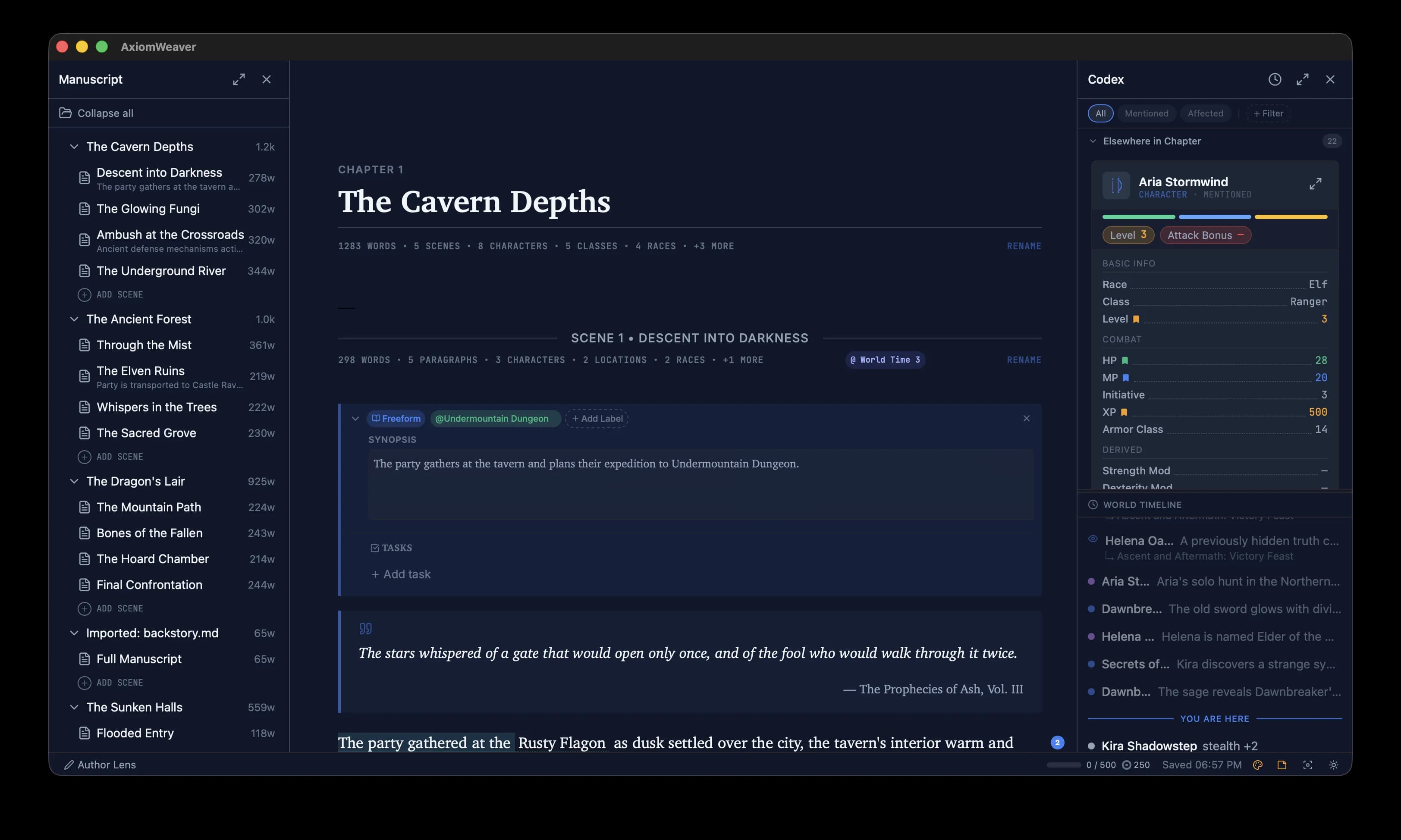
The editor, the manuscript, and the Codex — one window to write without switching context.
“Every tool made me choose between prose and world-building. Novel in my head, spreadsheet on my second monitor. So I built the tool I wish existed.”
Built for authors of LitRPG, Progression Fantasy, GameLit, Cultivation, and any fiction where the world has rules that matter.
Your process. Your rules.
Whether you outline every chapter or discover the story as you write it, AxiomWeaver meets you where you are.
Discovery Writer
“I’ll figure it out as I go.”
Start with a blank page. Write first, organize later. As you introduce characters, places, and systems, AxiomWeaver detects them in real time and builds your world knowledge base in the background. No upfront setup required.
- Auto-detection of entities as you write
- One-click entity creation from selected text
- Place events at any point in the timeline, even after the fact
- Organic world-building that grows with your draft
Architect
“I need the blueprint first.”
Define your world before you write a word. Build entity profiles, stat systems, faction hierarchies, and timeline structures upfront. The narrative engine validates your prose against the plan as you draft.
- Full entity and relation editors before drafting
- Multi-framework outlining (Hero’s Journey, Save the Cat, custom)
- Pre-built game system templates and stat blueprints
- Real-time consistency checks against your world rules
Most writers are somewhere in between. AxiomWeaver doesn’t force a workflow — it adapts to yours, and the narrative engine works the same either way.
The Toolkit.
Write your story. Track your world. Ditch the spreadsheet.
Table Stakes
Prose First.
- Distraction-Free Focus Mode
- Typewriter Scrolling & Dimming
- RPG-Style Draft Save Slots
- Live WPM & Sprint Tracking
- Blazing-Fast Global Search
The Unique Core
Narrative State.
- The Narrative Event Ledger
- Author Truth vs Reader Lens
- Real-Time Entity Intelligence
- Composable Mutation Templates
- Multi-Framework Outlining
LitRPG Optimized
The Crunch.
- Branching Skill Tree Logic
- Dynamic Level-Up Thresholds
- Relation-Scoped Stat Grants
- The Loop Test Timeline Engine
- Deep Faction Hierarchy Graphs
Three features no other writing tool has.
The Event Ledger
Every change in your world is a narrative event. Compute character state, inventory, and status effects at any specific point in your manuscript automatically.
The Spoiler Shield
Toggle between what you know and what the reader knows. Track reveals, secrets, and hidden lore across your manuscript without losing your mind.
The Loop Test
Native support for time loops, flashbacks, and parallel POV timelines. The narrative engine handles complex temporal logic so you don't have to.
Watch it work.
11 PM. You’re 47 chapters deep. Your protagonist Kira is about to face the Hollow King. Here’s what happens next.
You type a name. The engine recognizes it.
“Kira drew the Soulreaver from its sheath, feeling the familiar weight of—”
You pause. Does she still have the Soulreaver? In the old days, you’d Alt-Tab to your wiki, Ctrl+F through a mess of notes. Ten minutes later you’d find the answer and lose your flow.
But AxiomWeaver already knows. The moment you typed “Soulreaver,” the entity scanner recognized it. The card appears: Ch.12: Acquired · Ch.31: Enchanted (+15 Shadow) · Ch.38: Nearly lost. She has it. You keep writing.
Kira takes a hit. The math does itself.
“The Hollow King’s necrotic blast caught her full in the chest. She staggered, vision swimming.”
You type /event and log: Kira: HP −340. The Ledger knows she entered this chapter at 892 HP, took 120 from the Wraith ambush earlier, and now this. Her card updates: HP: 432 / 1200. Her Wounded modifier recalculates Strength. Her Combat Rating formula updates. No spreadsheet. No mental math.
You make a mistake. The engine flags it.
“She activated Void Step, blinking behind the King and—”
A yellow squiggle appears. You’d forgotten she burned mana on the Wraith ambush — Void Step requires 200 Mana, and she’s at 180. In the old days, this goes to print. A reader on Royal Road comments “um actually she couldn’t have done that” and you feel that specific shame of getting your own system wrong.
You backspace. She drinks a Mana Elixir first. /event → Consumable → Mana Elixir. The squiggle vanishes. Early validation is already catching basic mismatches — and deeper narrative intelligence is shipping weekly.
A new character appears. One click.
“From the shadows emerged Vex, the King’s Executioner, his twin blades dripping with—”
You select “Vex,” right-click, choose Add to Codex. Name pre-filled. You pick Character, assign the Assassin Blueprint, add one relation: Rival → Kira. Save. Check Kira’s card — Rival → Vex is already there. The bilateral relation created itself.
That’s one writing session. No Alt-Tabbing. No spreadsheets. No “wait, let me check my notes.” Just prose and the engine that understands it.
See it in action.
Not mockups. Not concepts. Real screenshots from the alpha.
Right-click. Add to Codex.
Your world builds itself as you write.
Select any word in your prose, right-click, and add it to your Codex as a character, item, location, or any entity type you’ve defined. No upfront planning required. Discovery writers, this one’s for you.
Living character sheets.
Every entity is a full game-style profile.
HP, MP, XP bars. Equipment slots. Active effects. Skill trees. All updated automatically as your story progresses. This isn’t a wiki — it’s a character sheet that knows what chapter you’re on.
Scrub through time.
See any character at any point in your story.
Drag the scene scrubber to see how a character’s stats, inventory, and status effects looked at any moment in your manuscript. “What was Borin’s HP in chapter 12?” — answered instantly.
Inline stat tracking.
The math lives right in your prose.
Hover over any event-tagged passage to see exactly what changed — which characters were affected, what stats shifted, and by how much. No switching to a spreadsheet. The ledger is always one hover away.
Think visually.
Your world, laid out on a corkboard.
Pin entity cards, scene summaries, sticky notes, and timeline markers to a freeform canvas. Connect them, rearrange them, see the shape of your story. For the writers who think in webs, not lists.
Design your systems.
Branching skill trees, built for fiction.
Define progression tracks with requirements, rewards, and branching paths. The engine enforces the rules you set — if a tier requires Level 10, your character can’t unlock it at Level 8. Your readers will never catch an inconsistency you missed.
What’s already built.
This isn’t a concept deck. The alpha is real, running, and in active development. Here’s what works today.
The Writing Experience
- Rich text editor — ProseMirror-powered with smart typography and inline formatting
- Chapter & scene tree — drag-and-drop manuscript structure with nested hierarchy
- Focus mode — typewriter scrolling, paragraph dimming, distraction-free writing
- World-aware spellcheck — Harper-powered grammar that knows your character names aren’t typos
- Find & replace — manuscript-wide search with regex, scope filtering, and safe character renaming
- Multi-format import — .docx, .md, .txt, .epub, and Scrivener with intelligent structure detection
- Scene synopsis & author notes — per-scene metadata without cluttering the manuscript
- Margin comments — inline annotations anchored to specific text ranges
- Corkboard view — visual card layout of scenes with drag-and-drop reordering
- Asset management — entity portraits, thumbnails, and images with automatic WebP conversion
The Narrative Engine
- Entity profiles — characters, items, locations with bilateral relations and properties
- Narrative Event Ledger — create, edit, and delete world-state events anchored to prose
- Author Truth vs Reader Lens — toggle between what you know and what the reader knows
- Real-time entity scanning — Aho-Corasick trie detects entities in prose as you type
- Stat systems — custom formulas, computed values, and modifier stacks
- Character sheets — bespoke layouts with stat bars, equipment grids, inventory, and skill trees
- Equipment & inventory — spatial equipment grids and WoW-style inventory with drag-and-drop
- Skill trees — interactive node graphs with prerequisites, unlock states, and progression events
- Entity sheets — projected state at any temporal position with inline edits that create ledger events
- Action system — parameterized actions with typed slots, guided event creation, and narrative previews
What’s coming next.
The alpha ships new features weekly. Here’s what’s on the workbench and what’s around the corner.
Shipping Now
Export & Publish
One-click export to EPUB, PDF, and DOCX. Direct Royal Road chapter formatting. The last piece to complete the write-to-publish loop.
Narrative Intelligence
Scene deltas that show exactly what changed (“Kira gained +5 STR this chapter”). Stat sparklines across 50 chapters. Consistency alerts before your readers find the mistakes.
Story Web
Your corkboard evolves into a story map. Typed plot edges (Causes, Foreshadows, Parallels), cause-effect suggestions from the ledger, and entity journey paths through your manuscript.
Coming Next
Serialized Fiction Mode
Built for authors who publish chapter-by-chapter. Release schedule calendar, buffer depth tracker, published chapter state with edit warnings, and multi-platform tracking for Royal Road, Patreon, and KU.
Prose Heuristics
Real-time inline feedback: filter words, echo detection, passive voice, adverb density, and sticky sentences. Context-aware — dialogue and narration are scored differently. No other tool does this.
Scene Archive
A parts bin for discovery writers. Archive scenes without deleting them — they disappear from your nav, word counts, and exports, but every entity tag and event stays intact. Restore anytime.
On the Horizon
Temporal World Map
Interactive maps where entity positions change as you scrub through the timeline. See your characters move across the world in sync with your prose.
Advanced Timeline
Multi-axis temporal model for time loops, parallel POVs, and flashbacks. Custom calendars and milestone markers for complex narratives.
Series Management
Shared entity libraries across multiple books. Maintain a series-level knowledge base and track consistency across 10-book epics.
From the blog.
Building in public. Dev updates, writing tips, and the honest story behind the tool.

Stop fighting your tools.
The alpha is free. I ship new features weekly. Request access and I’ll send you the download link.
or join the community on Discord (opens in new tab)
Rust Core
Sub-millisecond state projection. Zero-cost abstractions across millions of words.
Tauri 2.0
Desktop-native. Tiny memory footprint. No Electron bloat.
SQLite
ACID-compliant local storage. Your data never leaves your machine.
AxiomWeaver v0.5-alpha
Target: aarch64-apple-darwin
Engine: NarrativeState v2.1 (Rust)